1953
Whirlwind magnetic core memory operational
MITMassachusetts Institute of Technology — a research university central to many computing breakthroughs.'s Whirlwind computer began using magnetic core memory in 1953 — the first reliable high-speed random-access memory for computers.
What it was for
 Jay Forrester's core memory array of tiny ferrite rings became the dominant RAMRandom access memory — fast volatile memory used while programs run. technology until semiconductorA material whose conductivity can be controlled — silicon semiconductors are the basis of almost all computer chips. memory in the 1970s. Whirlwind itself was a real-time flight simulator for the Navy — core memory made fast, rewriteable storage practical at scale.
Why it's here
Magnetic core memory was the first practical high-speed RAMRandom access memory — fast volatile memory used while programs run. for digital computers.
Why it mattered
It enabled fast, reliable storage that every mainframeA large, powerful computer for centralized organizational workloads — dominated enterprise computing before PCs. and minicomputerA smaller multi-user computer from the 1960s–80s — affordable to departments rather than whole corporations. adopted for two decades.
What it solved
Earlier memory (delay lines, CRTCathode-ray tube — a display technology using electron beams; the classic bulky monitor. stores) was too slow or unreliable for real-time computing.
Media
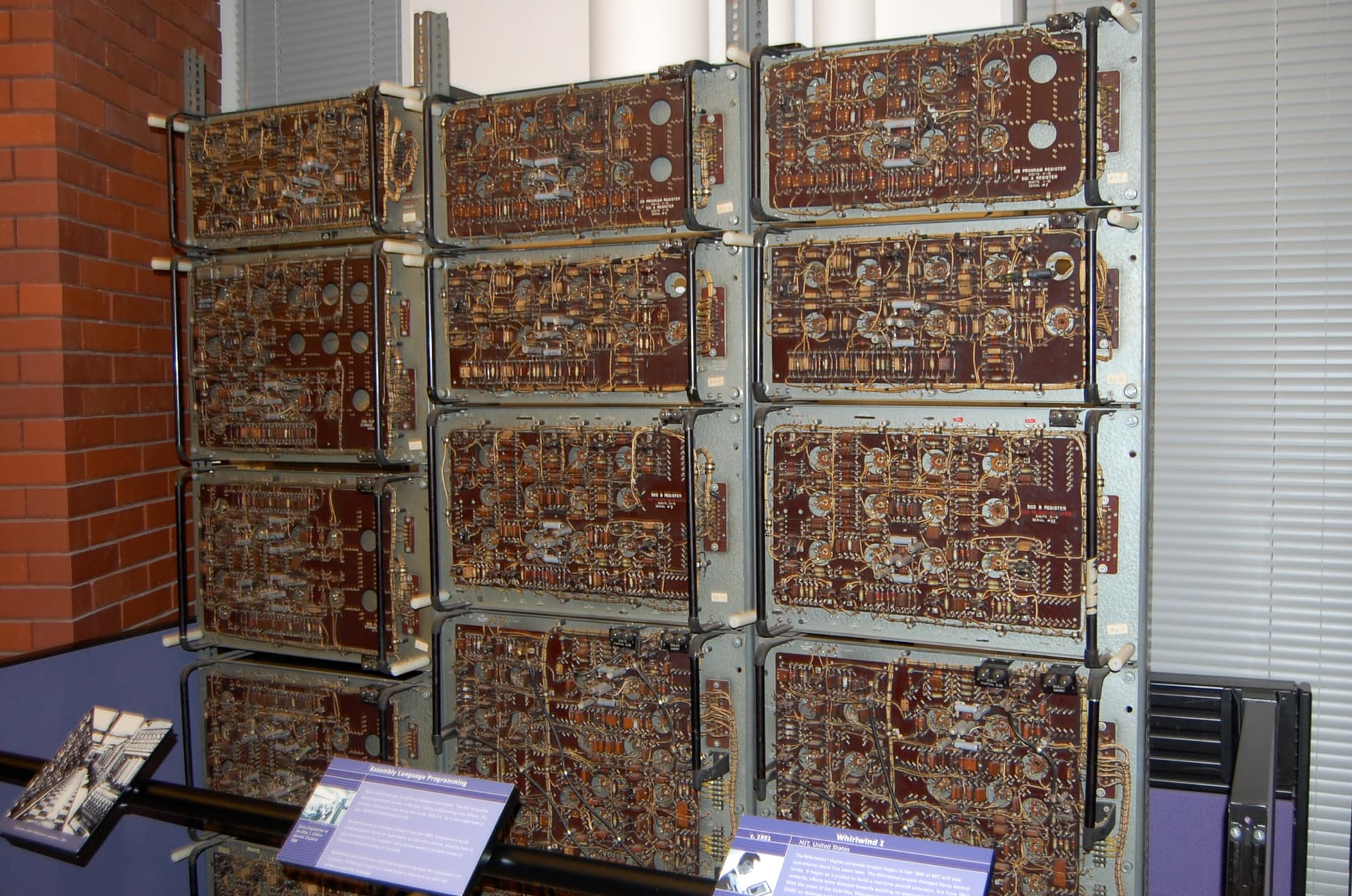 ImageWhirlwind computer
vonguard, CC BY-SA 2.0, via Wikimedia Commons
Related
- ENIAC formally dedicatedFebruary 15, 1946
- IBM RAMAC 305 announcedSeptember 14, 1956
- DEC PDP-1 introducedNovember 1960