May 8, 2000
SOAP 1.1 published
The W3CWorld Wide Web Consortium — the international body that maintains core web standards. published SOAP 1.1 as a Note on May 8, 2000 — an XMLExtensible Markup Language — a markup format for structured documents and data exchange. envelope format for remote procedure calls over HTTPHyperText Transfer Protocol — the protocol browsers use to request and receive web pages..
What it was for
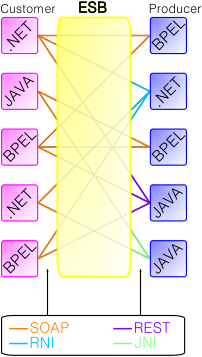 SOAP wrapped method calls in XMLExtensible Markup Language — a markup format for structured documents and data exchange. envelopes with headers and bodies — the backbone of early .NET ASMX services, JavaA portable language running on the JVM — dominant in enterprise servers, Android, and big data. JAX-WS, and enterprise B2B integrations. WSDL described endpoints; the WS-* stack added security and reliability. TeamsMicrosoft Teams — chat, video calls, and Office integration for workplace collaboration. used it when schemas, tooling, and corporate standards mattered more than JSONJavaScript Object Notation — a lightweight text format for structured data exchange on the web. simplicity.
Why it's here
SOAP standardized XMLExtensible Markup Language — a markup format for structured documents and data exchange. web services for a decade of enterprise and government integrations.
Why it mattered
It let JavaA portable language running on the JVM — dominant in enterprise servers, Android, and big data. and .NET systems interoperate through contract-first WSDL tooling.
What it solved
Ad-hoc XMLExtensible Markup Language — a markup format for structured documents and data exchange. RPC needed a common envelope, encoding rules, and HTTPHyperText Transfer Protocol — the protocol browsers use to request and receive web pages. binding for multi-vendor systems.
Media
- ImageSOAP
Silver Spoon, CC BY-SA 3.0, via Wikimedia Commons
Related
- XML-RPC protocol specifiedJuly 19, 1998
- REST architectural style defined2000
- SOAP 1.2 became a W3C RecommendationJune 24, 2003
- .NET Framework 1.0 releasedJanuary 15, 2002