June 24, 2003
SOAP 1.2 became a W3C Recommendation
The W3CWorld Wide Web Consortium — the international body that maintains core web standards. elevated SOAP to a full Recommendation on June 24, 2003 — making XMLExtensible Markup Language — a markup format for structured documents and data exchange. web services a formal web standard after the SOAP 1.1 Note.
What it was for
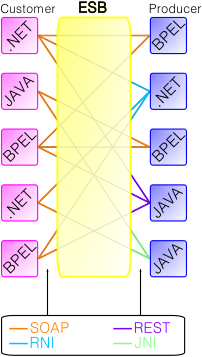 SOAP 1.2 cleaned up XMLExtensible Markup Language — a markup format for structured documents and data exchange. Infoset usage, split the spec into messaging framework and adjuncts, and dropped the 'Simple Object Access Protocol' acronym. Enterprise JavaA portable language running on the JVM — dominant in enterprise servers, Android, and big data. (JAX-WS), .NET WCF, and B2B integrations standardized on it before RESTRepresentational State Transfer — a style for web APIs using HTTP methods and resource URLs.+JSONJavaScript Object Notation — a lightweight text format for structured data exchange on the web. dominated public APIs.
Companies
- W3C
Why it's here
SOAP 1.2 was the peak formal standardization of XMLExtensible Markup Language — a markup format for structured documents and data exchange.-RPC-style enterprise web services.
Why it mattered
It gave vendors a normative target for interoperable SOAP stacks in government and banking.
What it solved
SOAP 1.1 was only a W3CWorld Wide Web Consortium — the international body that maintains core web standards. Note; large integrators needed a full Recommendation with test suites.
Media
- ImageSOAP
Silver Spoon, CC BY-SA 3.0, via Wikimedia Commons
Related
- SOAP 1.1 publishedMay 8, 2000
- XML-RPC protocol specifiedJuly 19, 1998
- REST architectural style defined2000